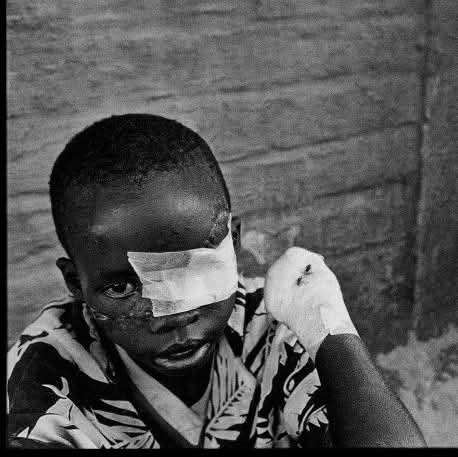
Révérien Rurangwa as a boy, shortly after the Mugina massacre, with bandages over his wounded eye and hand.
Rwanda, 1994 — days after Mugina.The wound over his eye. The bandaged hand. A boy who should not have survived.

His Story

The boy they left for dead.

He was fifteen years old. In one afternoon, on one hill, he lost forty-three people he loved and the sight of one eye. He should not have lived. He did — and he has spent his life since making sure the dead are named out loud.

This is his story, told the way he tells it: slowly, without decoration, and always with the names in front.

Chapter One

The hill before it changed

Mugina is a hill in central Rwanda, in what was then the prefecture of Gitarama. Before April 1994, it was an ordinary place: banana leaves heavy with rain, cattle moving along red paths, children sent to fetch water before school, evenings loud with a family that never stopped talking over one another.

Révérien was fifteen. He had a mother and a father, brothers and sisters, uncles, aunts, cousins, grandparents — a whole architecture of people. He knew whose laugh belonged to whom in the dark. He knew which neighbour would call his name across a field. That, too, mattered later: the killers were not strangers. They were faces from the market, from church, from the same hill.
Chapter Two

April 1994

On 7 April 1994, the killing began across Rwanda. Within days it reached the hills of Gitarama. Tutsi families fled upward, as they had in earlier persecutions, believing that a church or a hilltop might hold. This time nothing held.

The Genocide against the Tutsi was not chaos. It was organized: lists, roadblocks, radio broadcasts naming people and places, weapons distributed in advance, ordinary men told each morning where to go. Over roughly a hundred days, more than one million Tutsi were murdered — the fastest rate of killing of the twentieth century.

Chapter Three

Forty-three names, one afternoon

On 20 April 1994, they came for his family. In a single afternoon, forty-three of the people Révérien loved were killed with machetes and clubs: his mother, his father, his brothers and sisters, his uncles and aunts, his cousins, his grandparents. Not a distant statistic — a household, a lineage, a Sunday table.

They struck him too. Blades took his right eye, opened his face, cut his hand and his arm. He fell among his own dead and they left him there, certain he was finished. Night came. He opened the one eye he had left. He was alive, and everyone he belonged to was not.

He survived by being mistaken for a corpse among his own family.

Chapter Four

The long body, the longer memory

What followed was years of surgery and pain — reconstructive operations, infections, a body relearning how to be a body. But the wound he speaks about most is not the visible one. It is the silence that arrives when there is no one left to remember your childhood with you: no mother to correct the story, no brother to finish the joke.

He was taken in and eventually found his way to Switzerland, where he learned French well enough to do the hardest thing a survivor can do — set it down in words. Writing meant returning to the hill on purpose, every day, alone.

Chapter Five

Génocidé

His memoir, published in French as Génocidé (Presses de la Renaissance, later J'ai Lu) and in English as Genocide: My Stolen Rwanda, opens with the sentence that has followed him ever since: « Ils m'ont tué moi et toute ma famille sur une colline du Rwanda. Mais je ne suis pas mort. » — They killed me, and all my family, on a hill in Rwanda. But I did not die.

The book is not written for pity. It is written as evidence: names, dates, a hill, an afternoon. It refuses the comfortable abstractions — 'tribal violence', 'ancient hatreds' — and puts back what those words remove: forty-three specific people who were loved.

« Ils m'ont tué moi et toute ma famille sur une colline du Rwanda. Mais je ne suis pas mort. »

Chapter Six

A voice that travels

Since then Révérien has spoken at Kwibuka commemorations in Rwanda, in European institutions, at universities in Europe and Asia, in memorials, in classrooms of teenagers the age he was in April 1994. He speaks about warning signs — dehumanizing language, lists, propaganda, the slow permission a society gives itself before it kills.

And he speaks against denial, which he calls the final stage of the genocide: the attempt to murder the dead a second time by arguing them out of existence. Against that, he offers something denial cannot answer — a face, a scar, a name, and a witness still standing.

Timeline

A life, in dates.

  1. 1979

    Born in Mugina, in the hills of Gitarama, central Rwanda.

  2. 7 April 1994

    The Genocide against the Tutsi begins across Rwanda.

  3. 20 April 1994

    Forty-three members of his family are murdered at Mugina. He survives, gravely wounded.

  4. 1994–2000s

    Years of surgery, exile, and rebuilding a life in Switzerland.

  5. 2006

    Publishes Génocidé — his testimony, in his own words.

  6. Today

    Speaks internationally on memory, prevention, and denial; lives in Switzerland with his wife Jeanne and their son Ethan.

Beyond forty-three

His family was part of a far greater silence.

More than one million Tutsi — men, women, children, elders — were murdered across a hundred days in 1994. A million lives with names, faces, unfinished sentences, futures that were owed to them.

Révérien never speaks only for his own. He speaks for the hill next to his, and the one after that, and for every survivor still carrying wounds the world cannot see.

"I was given another day. I use it to speak for those who no longer can."

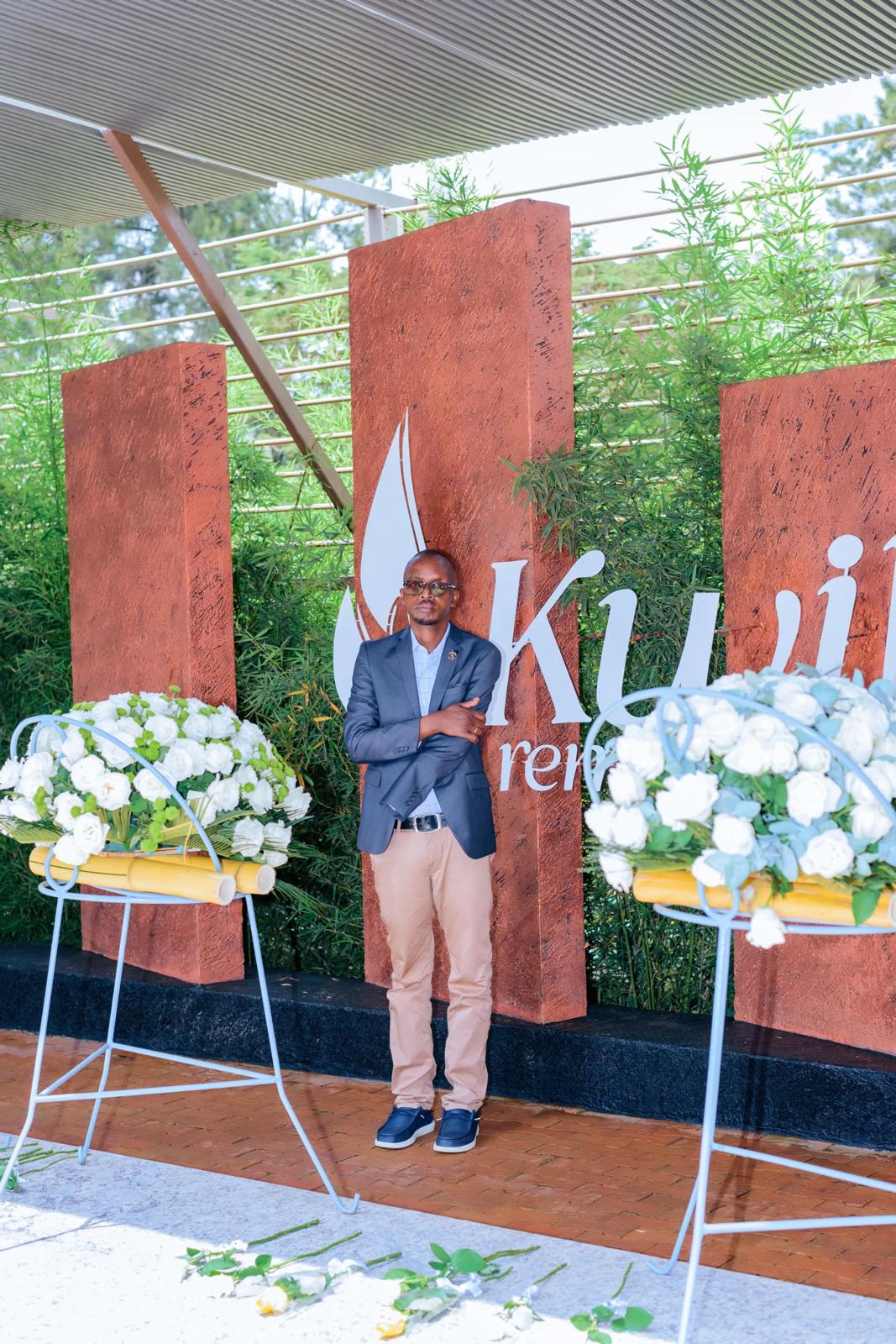
Révérien Rurangwa at the Kigali Genocide Memorial, beside wreaths of white flowers
Révérien at the Kigali Genocide Memorial — where more than 250,000 victims rest.

What happens in the room

They meet a family they never knew.

He could have chosen silence; silence would have been easier. Instead he chose memory — the harder, braver path. When Révérien speaks, an audience does not simply listen. They meet forty-three people by name, and they promise — quietly, each in their own heart — never to let this happen to another child, on another hill, in any country in the world.

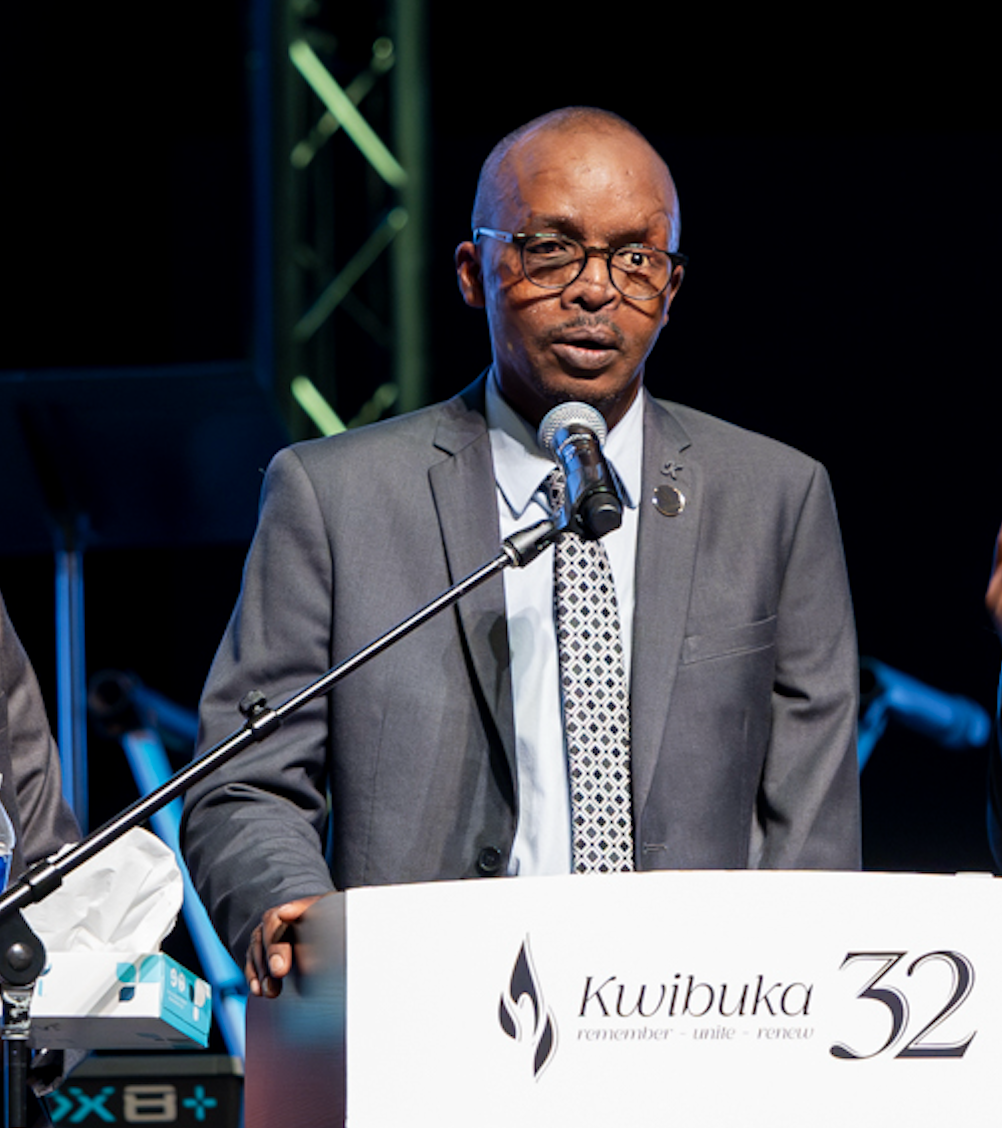
Révérien Rurangwa speaking at a commemoration event