Why He Speaks
Silence was never an option.
Révérien did not choose the stage. The stage was chosen for him — by forty-three loved ones, and by more than one million Tutsi whose voices were stolen in a hundred days.
To name the dead
So that his mother, his father, his brothers and sisters are not reduced to a number. Every talk is a roll-call for forty-three — and for a million more.
To fight denial
Because those who deny the Genocide against the Tutsi kill them a second time. He speaks so that history cannot be rewritten by those who wielded the machete.
To warn the world
Hatred does not begin with weapons. It begins with words. He teaches audiences to recognize the warning signs — before another hill, another country, another child.
To honor the survivors
For every Tutsi who lived through 1994 carrying wounds the world cannot see, he lends his voice — so their pain is witnessed, not erased.
To choose memory over hatred
Remembering is not revenge. It is the harder, braver path — and the only one that keeps a heart human after what he has seen.
For his son
So that Ethan grows up in a world that knows what happened in Rwanda in 1994 — and refuses, quietly and firmly, to let it happen anywhere again.
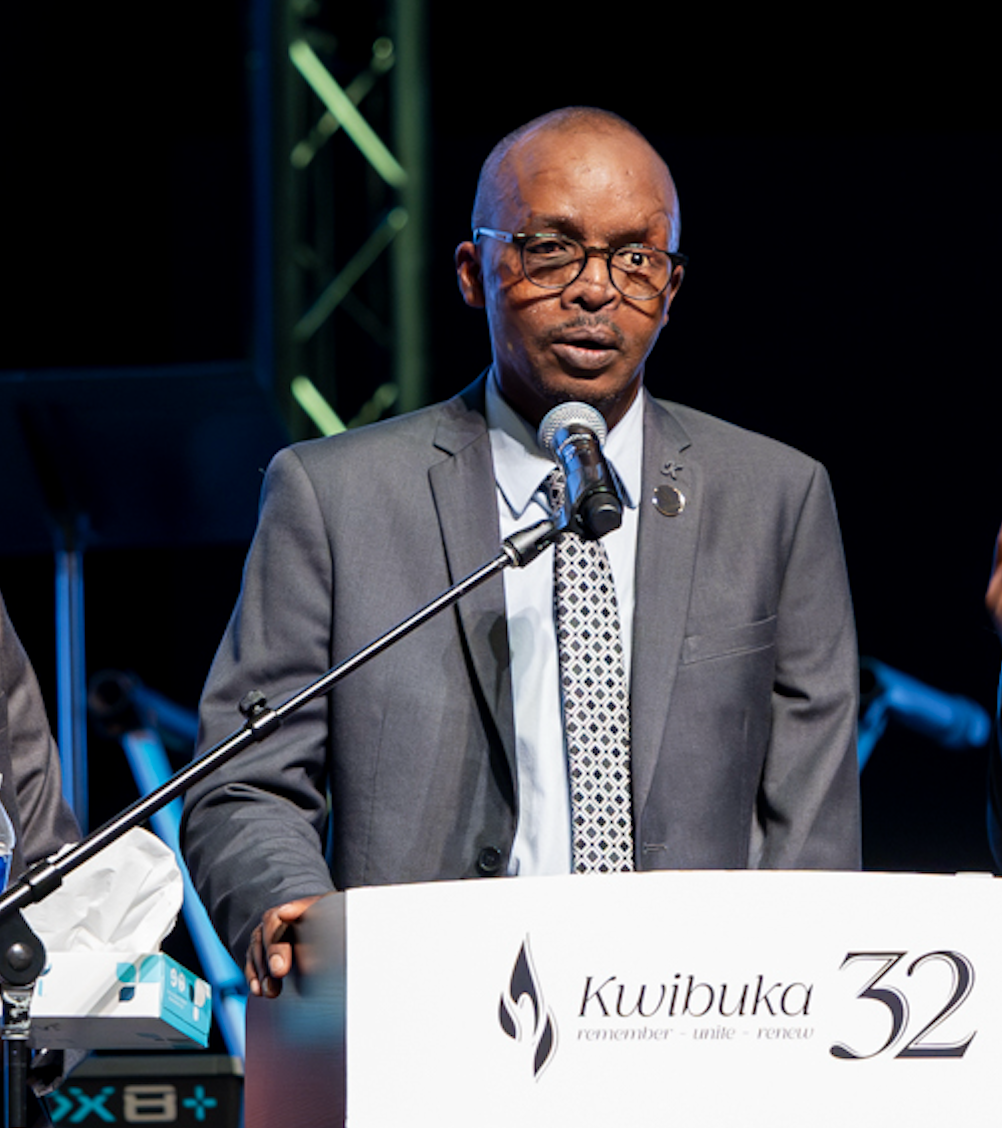
"I speak because they cannot. And as long as I can stand, I will not sit down."
The warning signs
Genocide is never sudden.
What he teaches audiences to see — because he watched every one of these steps happen on his own hill.
- 01
Language first
Before the machetes came the words: neighbours renamed as vermin, as a problem, as something less than human. Dehumanizing language is not talk. It is preparation.
- 02
Lists and labels
Identity written on a card, names written on a page. When a society begins sorting people into categories that can be counted, it has already begun deciding who is expendable.
- 03
Propaganda that permits
Radio and print told ordinary people that killing was duty, self-defence, hygiene. Genocide requires permission — and permission is manufactured in public.
- 04
The silence of others
In 1994 the world watched, debated a word, and withdrew. Indifference is not neutral; it is a resource the killers count on.
- 05
Denial afterwards
The final stage. Deny the numbers, deny the intent, blame the victims. Denial is not an opinion about the past — it is an attack on the dead in the present.